
To thoroughly implement the requirements for the integrated development of vocational education and industry-education integration, and to promote the organic connection among the education chain, talent chain, industry chain, and innovation chain, on September 21, a delegation led by Liu Shuo, Head of the Education Business Line of the Geely Talent Development Group, and Ren Xiaodong, Marketing Director, visited our college for a tour and discussion. Yang Ping, Chair of the Board of Dalian Maple Leaf College of Technology; Yang Jie, President; Gao Chenglin, Executive Vice President; and Gao Hongyin, Dean of the School of Innovation and Entrepreneurship, attended the discussion.
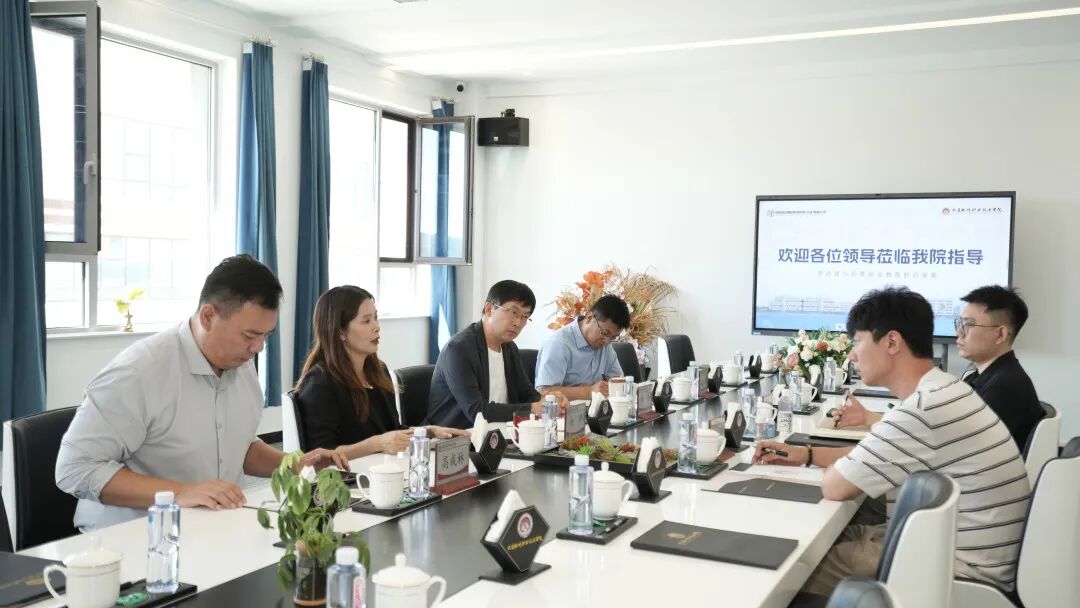
At the symposium, Chair of the Board Yang Ping, on behalf of the college, extended a warm welcome to the Geely delegation and gave a detailed introduction to the college's educational positioning, program layout, and the progress of its industry-education integration efforts. She stated that the college has always adhered to a market-oriented and employment-oriented educational direction, and that school-enterprise cooperation values pragmatism and emphasizes the long term. She expressed the hope of deepening cooperation with Geely—with its complete industry chain and strong brand strength—to achieve precise alignment between talent cultivation and industry needs.
Representatives from Geely introduced the company's overall industrial layout and its domestic and international development plans, and expressed their willingness to carry out joint talent cultivation relying on the school-enterprise cooperation platform. The two sides held candid and in-depth exchanges on specific cooperation paths, and fully exchanged views on such topics as the establishment of order-based classes and sponsored classes, bringing enterprise culture onto campus, study tours and academic visits, project-based teaching, and integrated secondary-and-higher vocational education.
After full communication, the two sides agreed that industry-education integration is a crucial lever for the high-quality development of vocational education, and that school-enterprise cooperation holds broad prospects and great potential. Going forward, the two sides will establish a regular communication and coordination mechanism, continuously explore points of cooperation synergy, and actively plan the next steps for collaboration, so as to pool joint efforts to cultivate technical and skilled personnel suited to industrial development and to support regional economic and social development.
This visit and exchange built a sound bridge for deep school-enterprise engagement and laid a solid foundation for the two sides to carry out multi-level cooperation in the next phase.